

 |
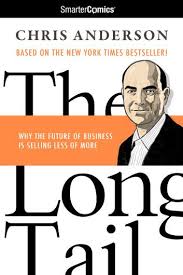
The Long Tail: Forget Squeezing Millions from a few Megabits at the Top of the Charts... |
In 1988, a British mountain climber named Joe Simpson wrote a book called Touching the Void, a harrowing account of near death in the Peruvian Andes. It got good reviews but, only a modest success it was soon forgotten. Then, a decade later, a strange thing happened. Jon Krakauer wrote Into Thin Air, another book about a mountain-climbing tragedy, which became a publishing sensation. Suddenly Touching the Void started to sell again.
Random House rushed out a new edition to keep up with demand. Booksellers began to promote it next to their Into Thin Air displays, and sales rose further. A revised paperback edition, which came out in January, spent 14 weeks on the New York Times bestseller list. That same month, IFC Films released a docudrama of the story to critical acclaim. Now, Touching the Void outsells Into Thin Air more than two to one. What happened? In short, Amazon.com recommendations. The online bookseller's software noted patterns in buying behavior and suggested that readers who liked Into Thin Air would also like Touching the Void. People took the suggestion, agreed wholeheartedly, wrote rhapsodic reviews. More sales, more algorithm-fueled recommendations, and the positive feedback loop kicked in.
Particularly notable is that when Krakauer's book hit shelves, Simpson's was nearly out of print. A few years ago, readers of Krakauer would never even have learned about Simpson's book — and if they had, they wouldn't have been able to find it. Amazon changed that. It created the Touching the Void phenomenon by combining infinite shelf space with real-time information about buying trends and public opinion. The result: rising demand for an obscure book.
More sales, more algorithm-fueled recommendations, and the positive feedback loop kicked in.
This is not just a virtue of online booksellers: it is an example of an entirely new economic model for the media and entertainment industries, one that is just beginning to show its power. Unlimited selection is revealing truths about what consumers want and how they want to get it in service after service, from DVDs at Netflix to music videos on Yahoo! Launch to songs in the iTunes Music Store and Rhapsody. People are going deep into the catalog, down the long, long list of available titles, far past what's available at Blockbuster Video, Tower Records, and Barnes & Noble. And the more they find, the more they like. As they wander further from the beaten path, they discover their taste is not as mainstream as they thought (or as they had been led to believe by marketing, a lack of alternatives, and a hit-driven culture). An analysis of the sales data and trends from these services and others like them shows that the emerging digital entertainment economy is going to be radically different from today's mass market. If the 20th-century entertainment industry was about hits, the 21st will be equally about misses.
Unlimited selection is revealing truths about what consumers want and how they want to get it in service after service.
For too long we've been suffering the tyranny of lowest-common-denominator fare, subjected to brain-dead summer blockbusters and manufactured pop. Why? Economics. Many of our assumptions about popular taste are actually artifacts of poor supply-and-demand matching — a market response to inefficient distribution. The main problem, if that's the word, is that we live in the physical world and, until recently, most of our entertainment media did, too. But that world puts two dramatic limitations on our entertainment. The first is the need to find local audiences. An average movie theater will not show a film unless it can attract at least 1,500 people over a two-week run; that's essentially the rent for a screen. An average record store needs to sell at least two copies of a CD per year to make it worth carrying; that's the rent for a half inch of shelf space. And so on for DVD rental shops, videogame stores, booksellers, and newsstands…
Enjoy this article? Feel free to share your comment, idea or opinion in the comment section
| Tags: | Books Sales Demand Consumers. |
Join the conversation

Related Articles

|
How Does Monetary Policy Affect Economic Growth?The central bank tries to maintain price stability through controlling the level of money supply. Thus, monetary policy plays a stabilizing role in influencing economic growth through a number of channels. However, the scope of such a role may be limited by the concurrent pursuit of other primary ob [Read more]
|
Posted: 15 years ago |
|
|
What Is The Credit Channel Of Monetary Policy Transmission?Monetary policy works in part by altering credit flows. The use of legal reserve requirements provide monetary authorities with considerable leverage over the quantity of funds that banks may maintain, just as open market sales reduces the real quantity of deposits banks can issue. This in turn indu [Read more]
|
Posted: 15 years ago |

|
Strategic Life PlanningStrategic planning is without doubt one of the main factors responsible for the continued success of an organisation and often distinguishes organizations that succeed from those that don't especially in the long term. Strategic planning, as an integral aspect of strategic management, enables or [Read more]
|
Posted: 9 years ago |

Management Challenge
Quote of the Day
Featured Video
Searching for Management Training Courses? Local or International?
Follow us on social media
Download Quarterly Guide
