

 |
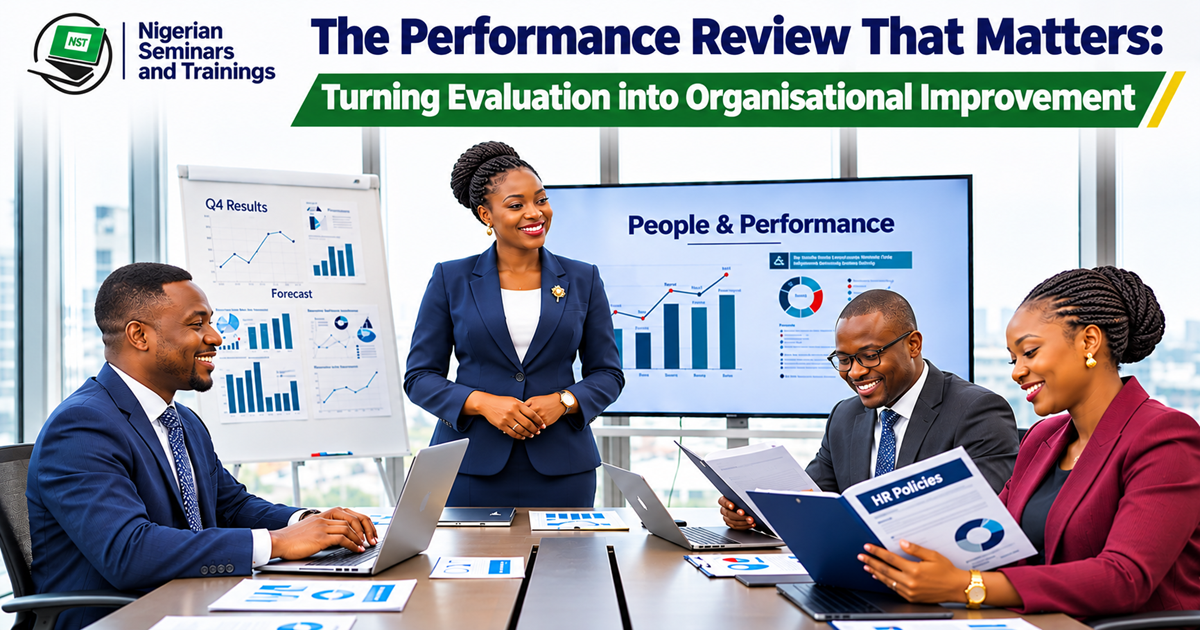
The Performance Review That Matters: Turning Evaluation into Organisational Improvement |
Performance evaluation should do more than measure what has been achieved. It should help organisations understand why results occur, identify what needs to change and determine how future performance can improve.
Organisations invest considerable time and resources in setting performance targets, monitoring activities and reviewing employee contributions. These processes are intended to establish whether responsibilities are being fulfilled and organisational objectives are being achieved. However, conducting performance reviews or generating reports does not automatically lead to better performance. An organisation may have detailed performance records yet continue to experience the same operational problems. Employees may receive feedback without understanding how to improve, while managers may identify performance gaps without taking appropriate corrective action. In such situations, evaluation becomes an administrative exercise rather than a management tool. The real value of performance evaluation lies in what organisations do with the information they obtain. It should provide a clear understanding of actual performance, reveal the factors influencing results and guide decisions that lead to improvement. For organisational leaders, this requires moving beyond measuring activities to examining effectiveness, accountability and the contribution of individuals, teams and processes to wider business objectives.
1. Establish Clear Performance Expectations
Effective evaluation begins with clearly defined expectations. Employees and teams need to understand what they are responsible for, the standards they are expected to meet and how their performance will be assessed. When expectations are unclear, performance reviews can become subjective. Managers may assess employees based on personal impressions rather than agreed responsibilities and measurable outcomes. Organisations should therefore establish clear performance objectives, relevant indicators and realistic standards for each role or department. These expectations should connect individual responsibilities to organisational priorities. For example, a customer service employee may be assessed not only on the number of enquiries handled but also on response quality, customer satisfaction and the effectiveness of issue resolution. Clear expectations provide a more consistent basis for evaluating performance and identifying areas requiring attention.
2. Measure Outcomes, Not Just Activities
One of the common weaknesses in performance evaluation is the tendency to measure activity rather than results. The number of tasks completed, reports submitted, meetings conducted or customers contacted may indicate how much work has been performed. However, these figures do not always demonstrate whether the intended objectives have been achieved. Organisations must distinguish between activity indicators and outcome indicators. For example, conducting employee training is an activity. Improved employee competence and better workplace performance are potential outcomes. Similarly, launching a marketing campaign demonstrates execution, but increased customer engagement or revenue growth provides a stronger indication of its effectiveness. This distinction helps managers determine whether resources are producing meaningful value. Performance measurement should therefore combine relevant activity indicators with measures that demonstrate quality, effectiveness and actual results.
3. Use Evidence to Identify Performance Gaps
Performance evaluation becomes more useful when decisions are supported by reliable information. Managers should examine actual results against established targets, review relevant performance records and identify differences between expected and achieved outcomes. However, identifying a gap is only the beginning. The next step is understanding why it exists. Poor performance may result from inadequate skills, unclear responsibilities, insufficient resources, ineffective processes, weak supervision or unrealistic expectations. Treating every performance gap as an employee problem can lead to inappropriate decisions and fail to address the underlying cause. Organisations should therefore investigate performance challenges objectively, consider the circumstances influencing results and distinguish between individual, team and organisational factors. A proper understanding of performance gaps allows managers to recommend improvements that address the actual problem rather than its symptoms.
4. Make Feedback Part of Continuous Performance Improvement
Performance evaluation should not be limited to annual appraisals or periodic management meetings. Regular feedback helps employees understand how they are performing and what they can do to improve. Effective feedback should be specific, constructive and connected to clearly established expectations. It should recognise achievements while addressing areas where performance falls short. Managers should also encourage employees to discuss challenges affecting their work, identify the support they require and participate in developing improvement plans. This creates a more constructive relationship between performance assessment and professional development. Feedback is also an opportunity to recognise effective practices that should be maintained or replicated across teams. When employees understand what they are doing well and where improvement is necessary, they are better positioned to take responsibility for their performance.
5. Translate Evaluation Findings into Corrective Action
Identifying performance weaknesses without taking action limits the value of evaluation. Once gaps and their underlying causes have been established, managers must determine the appropriate response. This may involve additional training, changes to work processes, improved resource allocation, clearer responsibilities, stronger supervision or adjustments to existing strategies. Corrective actions should be specific, realistic and assigned to responsible individuals or teams. For example, if an organisation discovers that delays in service delivery are caused by inefficient approval procedures, additional employee training alone may not resolve the problem. Reviewing the approval process and clarifying decision-making responsibilities may be more effective. The important consideration is that evaluation findings should lead to practical decisions rather than remain as observations in performance reports.
6. Monitor Improvements and Review Their Effectiveness
Performance improvement does not end when corrective action is introduced. Organisations must monitor whether the changes are producing the expected results. This requires establishing follow-up measures, reviewing progress and comparing new performance outcomes with previous results. If an organisation introduces a new process to reduce operational delays, for instance, management should examine whether processing time has improved, whether service quality has been maintained and whether additional problems have emerged. Where improvements are insufficient, further adjustments may be necessary. Regular monitoring also helps organisations recognise successful interventions and apply effective practices more widely. By making assessment an ongoing process, organisations can respond to changing conditions, improve decision-making and strengthen their ability to achieve established objectives.
The Role of Leadership in Making Performance Evaluation Effective
Performance evaluation is not solely an administrative responsibility assigned to human resource departments. It is an important management responsibility that requires active leadership involvement. Leaders must establish a culture where performance expectations are understood, results are reviewed objectively and employees are encouraged to take responsibility for improvement. They must also ensure that evaluation processes are fair, consistent and connected to organisational priorities. Importantly, managers should be willing to assess their own decisions and leadership effectiveness. Performance challenges may sometimes reflect weaknesses in planning, communication, supervision or resource allocation. When leaders recognise that evaluation applies to management decisions as well as employee performance, it becomes a more credible and effective organisational practice.
Conclusion
Performance evaluation should provide more than a record of completed assignments or achieved targets. It should help organisations understand the effectiveness of their activities, identify factors influencing results and determine what needs to change. Establishing clear expectations, measuring outcomes, using evidence, providing constructive feedback, implementing corrective action and monitoring improvements are essential to making evaluation meaningful. For professionals, this approach encourages greater accountability, and a clearer understanding of how their contributions support organisational objectives. For leaders, it provides a stronger basis for decision-making, resource allocation and continuous improvement. Ultimately, organisations improve when they are willing to examine their performance honestly and act on what the evidence reveals.
Final Takeaway
Performance evaluation is valuable only when it leads to better understanding, better decisions and better results. Measuring performance tells organisations where they stand. Acting on the findings determines how far they can improve.
| Tags: | Performance Management Performance Evaluation Accountability Organisational Effectiveness Continuous Improvement Leadership Development Results Measurement Employee Performance. |
Join the conversation
Related Articles

|
Change - From the Inside OutBeing exceptional at what you do is a function of your expertise and experience but there could be less conspicuous factors that determine the kind of results you get. For some time now, I have been asking myself 'what's really the main difference between upwardly mobile persons and those wh [Read more]
|
Posted: 9 years ago |

|
The CEO of the 21st century
What are the qualities and characteristics that help create successful leaders? Consider this four-point plan. With business leaders’ public—and private—behavior coming under increasing scrutiny, it’s becoming nearly impossible to avoid getting caught in a lie. Few things [Read more]
|
Posted: 17 years ago |
|
|
Monetary Policy Instruments Used By the CBNUntil about 1993 when OMO was introduced, the CBN relied almost exclusively on varying combinations of direct instruments of monetary control from time to time. These instruments included: credit ceilings, secretarial credit allocation, interest rate controls, imposition of special deposits, moral s [Read more]
|
Posted: 15 years ago |
